This summer I taught a fourth grade group in a special education extended year program. This was a great experience for me, and I was reminded how much I like teaching elementary children.
In math we worked on reinforcing basic computation and numbers and operations. However, as an integrated learning science project, we grew alfalfa sprouts, keeping a written class journal of the progress. So each day, in addition to describing the growth of the sprouts, I asked the children to measure their length. The rulers we used had only half and quarter inches on them, but initially the students would give their answer to the nearest inch. This gave me the impetus for convincing the kids they needed to use all the marks on the ruler, and not just the numbered inch marks.
So we started learning the benchmark fractions of ¼, ½, and ¾ .There was one activity that especially helped to get students to apply what they had learned. I brought in some rope (perhas it is more accurately called twine) and had each child get a partner to cut a piece that was their height. They laid down on the floor and their partner measured them against the rope and cut it for them. Then their rope was called by their name. So my rope would have been called a Marsha. I then instructed students to find and mark half by folding the rope in two equal sections. We marked the spot using masking tape. So on my rope I would have found half a Marsha. We then found ¼ and ¾ marks. In order to do this, one end of the rope must be designated as the starting point or “zero” and the other end as “one”.
Then I posed a question on the board. How many of you does it take to go from the classroom door to the gym door? I wrote each child’s name on the board, giving them a space to report their own findings. They took their own ropes and measured how many could fit down the hallway to the gym. They found it easier to do with the help of a partner. After they had written their findings on the board, I asked them why the answers were all different. Had someone done something wrong? They knew that it was because they were all different heights. I then explained that we need a common system of measurement, and that is why we use inches feet etc.
I had gone over the benchmark fractions for several days, but after we did this activity, they started to remember them and were using them in measurement with more ease. It was an active learning project that made an impression.
Sunday, August 22, 2010

Wednesday, May 5, 2010
A System for Teaching Beginning Algebra

The school where I work uses a program called Hands-On Equations to help students understand algebra concepts. This is my second year of helping students with this program, and I see some very real benefits. It was developed by Dr. Henry Borenson, and more information about the program can be found at www.borenson.com/.
Students use manipulatives to solve algebra equations. They begin with simple ones and progress to more complicated problems. They use a picture of a balanced scale and learn the rules for keeping it balanced; these are the same rules that are used for solving equations. This system enables students younger than those usually in algebra classes to begin to solve equations. And there are smart board programs available to go with the program. In my grade book, Hands-On Equations gets a an A!
Thursday, April 29, 2010
The Transformation Room: A Game to Improve Spatial Visualization
Spatial visualization, or the ability to mentally manipulate figures, is easier for some than others, but most teachers maintain that it is an ability that can be developed in students. One activity I have found and used is one of the games on www.mathplayground.com. The activity is found in the game “The X Detectives” . Upon entering the game, the little car can be driven to various locations. One location is “The Transformation Room” and that is where students can learn about reflections, translations, and rotations. A model is given to illustrate each concept, and then practice is provided. Players try to duplicate patterns in various positions by following the directions given. It is a good mental exercise and will not only reinforce the definitions of the terms reflection,translation and rotation, but will also serve to strengthen spatial visualization.
Wednesday, April 28, 2010
Working Backward to Improve Standardized Test Scores
One of the projects I started this year was to again look at my state’s math standards and then focus on how they are tested in the standardized test that students take every year. In my state, we refer to these standards as G.L.E.’s (Grade Level Equivalents) and the standardized test our students take is the N.E.C.A.P. (New England Common Assessment Program)
I set up a big binder with a divider and clear plastic sheet protector for each of the math GLE’s at my grade level, and also for the previous grade level which I try to review in the fall in preparation for the test. I went to the school’s library and made copies of all the math released items from the NECAP tests. There were about five years of them. I cut apart each question and identified which GLE it tested and put it in the plastic sleeve for the corresponding GLE. Doing all the items was time-consuming, but the results were worth it.
Over the years I could see which standards were tested more heavily, and this was helpful. But more than that, I now have a question bank for each skill. When teaching a specific math skill, I can look at how questions are asked to assess that skill. I can see how different vocabulary is used, and in many cases, the question is worded differently from how I would ask it , or how our math book asks it. I can give students sample questions throughout the year, and not just at practice test time. And I can save the questions I create and add them to my collection in the binder.
This approach has certainly been working backward; I started with the test and worked to match a skill to it rather than the other way around. But I have gained some good information from it.
Thursday, April 15, 2010
Better Than Luck
There is an activity I like to do with my classes when they are in the probability unit. I start by holding up my brown paper bag and telling them that there are colored tiles in the bag. I pull out one tile of each color to show them as I say there are red tiles, blue tiles, and green tiles. And there are twenty tiles total in the bag. Can they now predict how many of each color are in the bag? At this point, some try, but I point out they are just making random guesses. I do encourage them to write down their guess to see how lucky they will be.
Next, I go around the room letting each student pull out one tile from the bag without looking. They must put it back in the bag once we have seen what color it is. Another student keeps a tally on the board. We do this several times to get some data. Then we proceed to turn the data into a fraction of how many picks were of each color. The fraction is then turned into a decimal, and then a percent. Next, we use the percent to make our (educated) guess about how many of the tiles are red, blue and green. For example, if 25% of our picks were blue, we would guess that there are 5 blue tiles in the bag because 5 is 25% of 20.
After figuring out all of our guesses, known as experimental probability, and discussing our final hypothesis and the process used to make it, we are ready for the “big reveal”. We examine how close we came and most always discover that statistical data based upon probability is better that just plain old luck!
Thursday, April 8, 2010
Exploring Careers
I wrote about this website last year, but didn't get my students using it as much as I have been doing with them lately. The website is:
www.xpmath.com
There is a variety of information on there including a "math arcade" where students can play games that help them with specific skills.
But this week I asked my students to do a little research into careers using this website. I typed up a worksheet that has two parts. The first part asks them to list a career or occupation and then tell how many math skills are used by someone in that field. They then have to list some of the math skills listed for that job. This is accomplished by clicking on "math jobs". The second half of the worksheet has the students list a math skill and how many careers in the database require that math skill. They then list a few of the careers. A simple click on one of the math skills gives this information.
The worksheets make an impressive display on my wall and students can see not only that math is important in everyday life, but that being proficient at math skills will give them more careeer options.
Monday, April 5, 2010
One Hundred Eighty Degrees
There is an activity I like to do to help kids remember that the number of degrees in a straight line and the sum of the angles in a triangle are the same number. It is a good visual demonstration to drive the point home.
On a piece of paper draw a straight line using a ruler. This can also be done on an overehead transparency if you are demonstrating it for a whole class. Have several triangles cut out of construction paper. I ususally have one that is scalene, one that is isosceles, and one that is equilateral. Tear off the three angles of the triangle and arrange them with their points together on the straight line. I do this with each of the three different triangles.
Some years, I have told the class that I would give ten dollars to anyone that could come up with a triangle that had angles that didn't fit together on a straight line. But I am sure that I will never have to pay up, because it works for every triangle every time!
Tuesday, March 30, 2010
ETA Cuisenaire Daily Math Reinforcers
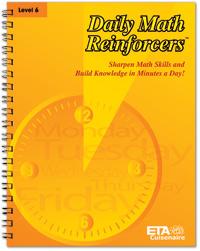
I've been using this resource for nearly ten years, and it has been a tremendous way to improve student math skills as well as review and pre-teach concepts that need to be met. These work well as a warmup for math classes as well as a tool for remedial groups. There are three sheets to each reproducible page. Each daily sheet has a mental math section, a word problem, and a skill review section. The newest edition of the manual also includes concept sheets and section quizzes. The series has a book for each of grades 1-8.
The mental math section has three questions which I just read to the class. I usually read them twice and ask the students to answer the questions by thinking about it, but not by writing anything down except the answer. I've seen a number of students improve tremendously in the area of mental math as the year progresses. When we go over the questions, we share how we thought about the problem to get the answer. Then we realize that there is often more than one way to solve the problem. Sometimes we have the opportunity to correct faulty reasoning or misconceptions.
The word problem section requires students to list the steps to solving the problem in a format that fits the acronymn, TIPS. (Thought, Information, Plan, Solution)Occasionally, problems are given that do not have enough information to solve. Students know this and if there is not enough information, they write NEI and then tell what information they would need to solve the problem.
When I was teaching regular ed middle school math, I started many of my classes with this activity as a warm-up. I handed the slips out as students came in the door, and then just went to the front of the room and started by saying "Number 1" which was the mental math section. When I did this, students settled right down. I allowed about eight minutes for the work. Now as a remedial teacher, I often use these daily warm-ups with my students. In both situations, I go over the slips inviting students to give answers and model solutions.
The ADD acronymn is on every sheet for Arithmetic Daily Developed. This series has truly helped my students become more proficient in math.
Thursday, November 5, 2009
A New Math Word
My husband's seventh grade class has come up with a new math term! In science they have learned that the prefix "eu" means true. So eubacteria, as opposed to archeabacteria, means true bacteria. And eukariotic means true nucleus.
In math, they are learning about variables. Now the definition of variable is "a value that can change". In the the equation y=2x + 5, the variables are x and y. And their values can change.
But sometimes variables or letters are used just to hold a place and the value is pre-determined. An example of this is in the equation 2x +3 = 7. In this case x=2 and the variable is holding the place of the 2.
So the new math word? Here it is: EUVARIABLE!!! It means a true variable and not just a place holder.
Congratulations to my husband and his seventh graders! Good thinking!
Integer Hi-Lo
I came up with a new game and my last period eighth grade group named it! I needed to review multiplying integers with them.
I started by dividing the students into groups of two, three, or four and giving them a deck of cards. I wrote on the board that black cards were positive and red cards were negative. I told them it was that way with the phrases "in the black" and "in the red."
The dealer hands out all the cards to the players. The cards are placed face-down and the players don't look at them. Whoever has been designated to go first puts out one card. If it is black, they are looking for the highest product; if it is red, they are looking for the lowest product. Then the first player lays out another card and announces the product of his two cards. The next player puts out two cards and announces their product until all players have done this. They then decide who has the high or low depending on what they are looking for based on the first card out. The winner takes all the cards and puts them under their deck face-down.
Players are trying to end up with all the cards. If there are more than two people playing, I cut the game off when one person has no cards and the person with the most is declared the winner. If the class ends, the person with the most cards wins.
This is a good game not only for multiplying integers, but also comparing integers. Sometimes students struggle with the concept that -50 is less than -1, and this game helps them review magnitude.
Wednesday, October 21, 2009
A Kiss For You!

This morning I was going over multiplication with one of my math groups. After doing some basic drill, we were using individual white boards to practice multiplying multi-digit numbers using the standard algorithm. I would give them the problem and wait for them to do it individually. Then I would do the problem on my own white board using think-aloud, so they could compare their work. They were doing a fine job, and only making a few mistakes.
At one point I went to my desk and wrote a note on a piece of scrap paper: "I am going to do the problem wrong. I wonder if anyone will notice. A kiss if they do!" I then proceeded to do the problem incorrectly. It was just one mistake that I made; I said that 7 x 5 =40. At first no one said anything. Then when I paused, one of them said, "What?" I replied that I would be happy to do it again, and proceeded to do that section of the problem again making the same mistake. This time, they spoke up. I showed them my note and praised them for finding my mistake and handed over a Hershey kiss to each one.
They were thrilled! And so was I. A big part of doing math accurately is watching for and catching mistakes. My initial motivation for this was that I had a bag of kisses in my desk that I needed to use up. I had bought the candy for an activity with another group, and being diabetic myself, had no other use for them. But I was reminded that making a mistake and praising students for catching it is a good thing to do!
Friday, October 9, 2009
There's A Lot of Math in a Tree

On the day before school started, I was asked to teach a last period class for remedial students that would help them improve their math skills in addition to the regular grade 8 math class they already were taking. I welcomed the opportunity and it has been a good experience this fall. But there was no room assigned for the class that first week, so students were told to meet me at the office and together we walked outside to the woods behind the school. I handed them meter sticks and clipboards, told them to find a partner and sent them to measure trees in the woods. They were to find the d.b.h. or diameter breast height. This gave us some wonderful data for reviewing measures of central tendency such as mean, median, mode and range. Using all the data, we were able to make some generalizations about the trees in the forest.
Currently, my husband is in a science/math forestry unit with his seventh and eighth graders. The extension forester comes in and they have been doing some incredible explorations that have captured the students' interest and strengthened their math skills and science knowledge at the same time. They are measuring trees, calculating board feet and projecting the dollar amount that various wooded areas are worth.
At this time of year when the autumn colors are so vibrant, it's nice to find so much math in the trees!
Thursday, August 6, 2009
Everything Has to Do With Math
I was talking to my friend Catherine. She was saying that she didn't like to put on a wet swimsuit. So I told her the trick I use if I am in a place where the only suit I have is wet: run it under hot water from the sink and wring it out before putting it on. She enthusiastically welcomed my tip and said that it was something worth putting on my blog for everyone to see. When I replied that it didn't have anything to do with math, she replied, "Everything has to do with math!" She proceeded to note that it had to do with the measure of body temperature compared to the temperature of the wet suit. When the temperature of the suit is raised to a temperature equal to or higher than body temperature, there is less discomfort. Not a bad observation for a social worker!
So is it true that everything has to do with math? I have thought about asking students to tell how they used math over their summer vacation. While most will think that they didn't at all, I hope I can eventually get them to realize that math is associated in one way or another with most everything we do. So let's see if it works for what I do.
I just finished washing the dishes. (No, I don't have a dishwasher.) I put the glasses and silverware in the soapy water first and save the dirtier and larger dishes for later. The reason I save the dirtier dishes for later is that I want my dishes to end up clean and the ratio of dirt particles to water needs to be low. When I finally put the really dirty dishes into the water, it increases that ratio of dirt to water. Ratio? Math?
So how else have I used math over this summer vacation? Well, while I was sitting and healing from (yet another) surgery on my foot, I got involved in one of those farm simulation games on Facebook. I plow, plant, and harvest and watch my coins accumulate. I have to buy the seeds from the store, and I try to figure out which will be the best crop for me to grow. It's all based on math!
Thankfully, I haven't spent the whole vacation in a recliner with my foot up. On our trip to Newport, RI, I used a map, roadside mileage markers, and the car's speedometer to try to figure out how much longer it would take. The everyday estimates we make are all based on our knowledge of math.
So is it really true that everything has to do with math? I think it is, whether I can explain the connection or not. But it is a good mental exercise to try to figure out those connections. Maybe I'll contemplate it further when I'm floating in the pool this afternoon!
Wednesday, August 5, 2009
See Who Laughs!
This is a joke my father used to tell. I tell it to my classes and then watch their reaction. I can tell right away who gets it and who doesn't.
One day a man went into a pizza parlor and ordered a pizza.
The waiter asked him,"Would you like your pizza cut into six slices or eight slices?"
After thinking for a moment, the man replied,"Well, you'd better cut it into six slices; I could never never eat eight!"
This is a good time to point out that fractions that have the same numerator and denominator always equal 1 or 6/6 =8/8
Friday, July 17, 2009
The Book That Might Disappear

My husband came home from an educators’ conference with several new books and one of them caught my eye in addition to hearing him mention it several times. The name of the book is Mathematics: Worksheets Don’t Grow Dendrites. It is written by Marcia L. Tate who is an educational consultant. She has written several books that have the Worksheets Don’t Grow Dendrites mantra in their title and this one is about math. She maintains that learning occurs the best when it centers around activities that involve and engage the student. This is a concept that I have believed for years, but finding or dreaming up enough activities to teach all the math concepts in my curriculum is quite a challenge—something I have spent many years doing.
As I began to flip through the book, it became obvious that it is a valuable resource. Chapter 2 is titled “Drawing and Artwork”. I see a project for “Gallon Man” which is used to help children remember the number of quarts in a gallon, pints in a quart, and cups in a pint. My middle school students have a hard time remembering this and here is an art project that can help! I love it: art projects that teach math!
The other chapters look good too, with a lot of practical ideas that can be used or expanded. You know, my husband loses things pretty easily and this book just might disappear for a while!
Wednesday, June 17, 2009
My Special Number: 25

For many years I assigned an end-of-unit project to my sixth graders titled My Special Number. This was when students would pick a number on which to perform a number study. Today I offer my own version of this assignment.
My special number is 25. It is a number that is described as odd, composite, and square. It is odd because it is not divisible by two. It is composite because its factor pairs are not only 1 x 25, but also 5 x 5. Having 5 x 5 as a factor pair is also what makes it a square number. In fact it is the smallest square number that is the sum of two other square numbers. ( 9 + 16 = 25) This relationship is found in many right triangles (known as 3-4-5 triangles) used for illustrating the Pythagorean Theorem.
Because 25 is a factor of 100, it is used in a variety of ways. A twenty-five cent coin is a quarter and it takes four to equal a dollar. 25% is equivalent to ¼.
The number 25 has significance in various religions and philosophies. According to Abellio, twenty-five is the symbol for the Universal Word of God. St. Augustin used it to represent the law. In the Bible, King Solomon builds a temple to God that is 25 cubits high, and a Levite could begin practicing his ministry at the age of twenty-five.
But today, the number twenty-five has a special significance. Today marks the day that indicates that FOR TWENTY-FIVE WONDERFUL YEARS I HAVE BEEN MARRIED TO THE BEST HUSBAND I COULD POSSIBLY HAVE!
Tuesday, June 2, 2009
The Daily Fraction

One ongoing activity that I like to do with my seventh grade classes is the daily fraction. This lends itself well to seventh grade because by then, students have been taught most fraction skills. There are a few that just didn’t get it, while some others have attained mastery, and the daily fraction works with both kinds of students. This activity takes about one minute a day and serves to review and for some re-teach a number of fractions concepts. It is a great point of discussion for students to notice and participate in.
I start at the beginning of the year by making a fraction template on a piece of white cardstock or construction paper. The template has the divide line with 180 as the denominator. I laminate it twice to withstand the daily write-on/wipe-off process. On the first day of school I use a dry erase marker to write a 1 as the numerator and say to the class, “When you go home today, one one-hundred -eightieth of the school year will be completed.”
On the second day, the one has been erased and a 2 is in its place. I ask the students to reduce the fraction and they realize that 1/90 of the school year is completed that day. We compare the two fractions noting that 1/90 is greater that 1/180.
Many days I ask the students to write the reduced form of the fraction on the back of their warm-up sheet, then discuss implications. I might ask them how close to 1/8or 1/4 of the year we are (midterm progress reports or report cards). I might ask for the percent of the year that has gone by or the fraction that is left.
Seventh-graders like to keep track of the year’s progression. Some years, students have felt that the year zoomed by and other years, it seemed very slow to them. But every day they are getting a little reminder of fraction skills through this number study.
So today is the 166th day of our school year. That's 83/90 of the school year completed with 7/90 to go. Or we could say that 92% of the year is finished with 8% left to complete. That translates to fourteen more days of school left!
Tuesday, May 26, 2009
Sweet Success

About a month ago, I wrote about a student who needed to learn some of the multiplication facts. We picked ten facts she needed to learn and wrote them on flash cards. We practiced and drilled and she got better. She made 90% or nine out of the ten. Now that is a high score that would bring an A grade in any school.
But consistently the one fact that she could not remember was 7 x 6 = 42. Whenever that fact would come up, the look on her face clearly communicated to me not only that she didn’t know it, but that she knew this was the one that she didn’t know and was convinced she would never be able to remember.
So one day, I let her use some art supplies to make a poster that now hangs in my room. And sure enough, even with her back to the poster, she can remember that 6 x 7 is 42. The visual and tactile experience of creating this poster focused on what she needed to learn has brought her to 100% success.
It's All About Pizza

Even though I have started my fractions groups by using giant cookies and a recipe for mushroom sandwiches, the example I use the most when talking about fractions is pizza. I spent some time this morning cutting out large red paper circles. Some of them I cut into halves and some I cut into fourths. I will use them as visuals when I talk about pizza slices and improper fractions and mixed numbers.
Improper fractions simply tell how many pieces there are and what kind of pieces they are. They are usually not the best way to express a number, but sometimes they are necessary. So if I have nine fourths, I have nine pieces that have been cut into fourths (which means four for every whole pizza). Using my visuals, students can see that every group of four makes a whole pizza. They find that two whole pizzas can be made with one piece left over. After some practice with this concept, I help them to verbalize the analog for how to change an improper fraction to a mixed number.
Then we move on to starting with a mixed number and changing it to an improper fraction. The pizza slices come in handy once again as students can beak down the wholes to see how many parts there are. Together, we come up with the steps for doing this process without the pizza slices.
The worst part of all of this is that the kids complain that these exercises make them hungry. It has an effect on me too—“Hello, Pizza Hut? I’d like to order a large pizza to be delivered to the school!”
Wednesday, May 20, 2009
From Cookies to Mushrooms
Today I will see how much my RTI students remember about the fractions skills I went over on Monday. I made a handout with one of my favorite snack recipes (that I got from my mother-in-law). Then I ask students to answer some questions. Here it is:
If you like mushrooms, try this recipe sometime.
Hot Mushroom Sandwiches
2 4-ounce cans mushrooms
1 T onion, finely chopped
2 T mayonnaise
5 slices rye or wheat bread
grated Parmesan cheese
Drain and chop the mushrooms. Add the onions and mayonnaise and stir. Spread evenly on the bread slices. Sprinkle with Parmesan cheese. Broil until lightly browned. Serve hot. Makes 5 sandwiches.
If two people share this recipe, how many sandwiches will each one get?
Express your answer as an improper fraction:
Express you answer as a mixed number:
Write a complete sentence that best answers this question:
Because five sandwiches are being shared or divided by two people, the improper fraction is 5/2. As a mixed number, that would be 2 1/2 sandwiches.
After doing the drill and this activity, we will review reducing fractions by playing NASCO's Fraction Simplification Bingo.
Subscribe to:
Posts (Atom)
