I wrote about this website last year, but didn't get my students using it as much as I have been doing with them lately. The website is:
www.xpmath.com
There is a variety of information on there including a "math arcade" where students can play games that help them with specific skills.
But this week I asked my students to do a little research into careers using this website. I typed up a worksheet that has two parts. The first part asks them to list a career or occupation and then tell how many math skills are used by someone in that field. They then have to list some of the math skills listed for that job. This is accomplished by clicking on "math jobs". The second half of the worksheet has the students list a math skill and how many careers in the database require that math skill. They then list a few of the careers. A simple click on one of the math skills gives this information.
The worksheets make an impressive display on my wall and students can see not only that math is important in everyday life, but that being proficient at math skills will give them more careeer options.
Thursday, April 8, 2010

Monday, April 5, 2010
One Hundred Eighty Degrees
There is an activity I like to do to help kids remember that the number of degrees in a straight line and the sum of the angles in a triangle are the same number. It is a good visual demonstration to drive the point home.
On a piece of paper draw a straight line using a ruler. This can also be done on an overehead transparency if you are demonstrating it for a whole class. Have several triangles cut out of construction paper. I ususally have one that is scalene, one that is isosceles, and one that is equilateral. Tear off the three angles of the triangle and arrange them with their points together on the straight line. I do this with each of the three different triangles.
Some years, I have told the class that I would give ten dollars to anyone that could come up with a triangle that had angles that didn't fit together on a straight line. But I am sure that I will never have to pay up, because it works for every triangle every time!
Tuesday, March 30, 2010
ETA Cuisenaire Daily Math Reinforcers
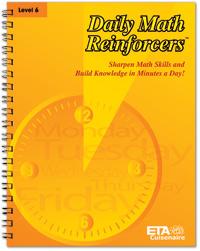
I've been using this resource for nearly ten years, and it has been a tremendous way to improve student math skills as well as review and pre-teach concepts that need to be met. These work well as a warmup for math classes as well as a tool for remedial groups. There are three sheets to each reproducible page. Each daily sheet has a mental math section, a word problem, and a skill review section. The newest edition of the manual also includes concept sheets and section quizzes. The series has a book for each of grades 1-8.
The mental math section has three questions which I just read to the class. I usually read them twice and ask the students to answer the questions by thinking about it, but not by writing anything down except the answer. I've seen a number of students improve tremendously in the area of mental math as the year progresses. When we go over the questions, we share how we thought about the problem to get the answer. Then we realize that there is often more than one way to solve the problem. Sometimes we have the opportunity to correct faulty reasoning or misconceptions.
The word problem section requires students to list the steps to solving the problem in a format that fits the acronymn, TIPS. (Thought, Information, Plan, Solution)Occasionally, problems are given that do not have enough information to solve. Students know this and if there is not enough information, they write NEI and then tell what information they would need to solve the problem.
When I was teaching regular ed middle school math, I started many of my classes with this activity as a warm-up. I handed the slips out as students came in the door, and then just went to the front of the room and started by saying "Number 1" which was the mental math section. When I did this, students settled right down. I allowed about eight minutes for the work. Now as a remedial teacher, I often use these daily warm-ups with my students. In both situations, I go over the slips inviting students to give answers and model solutions.
The ADD acronymn is on every sheet for Arithmetic Daily Developed. This series has truly helped my students become more proficient in math.
Thursday, November 5, 2009
A New Math Word
My husband's seventh grade class has come up with a new math term! In science they have learned that the prefix "eu" means true. So eubacteria, as opposed to archeabacteria, means true bacteria. And eukariotic means true nucleus.
In math, they are learning about variables. Now the definition of variable is "a value that can change". In the the equation y=2x + 5, the variables are x and y. And their values can change.
But sometimes variables or letters are used just to hold a place and the value is pre-determined. An example of this is in the equation 2x +3 = 7. In this case x=2 and the variable is holding the place of the 2.
So the new math word? Here it is: EUVARIABLE!!! It means a true variable and not just a place holder.
Congratulations to my husband and his seventh graders! Good thinking!
Integer Hi-Lo
I came up with a new game and my last period eighth grade group named it! I needed to review multiplying integers with them.
I started by dividing the students into groups of two, three, or four and giving them a deck of cards. I wrote on the board that black cards were positive and red cards were negative. I told them it was that way with the phrases "in the black" and "in the red."
The dealer hands out all the cards to the players. The cards are placed face-down and the players don't look at them. Whoever has been designated to go first puts out one card. If it is black, they are looking for the highest product; if it is red, they are looking for the lowest product. Then the first player lays out another card and announces the product of his two cards. The next player puts out two cards and announces their product until all players have done this. They then decide who has the high or low depending on what they are looking for based on the first card out. The winner takes all the cards and puts them under their deck face-down.
Players are trying to end up with all the cards. If there are more than two people playing, I cut the game off when one person has no cards and the person with the most is declared the winner. If the class ends, the person with the most cards wins.
This is a good game not only for multiplying integers, but also comparing integers. Sometimes students struggle with the concept that -50 is less than -1, and this game helps them review magnitude.
Wednesday, October 21, 2009
A Kiss For You!

This morning I was going over multiplication with one of my math groups. After doing some basic drill, we were using individual white boards to practice multiplying multi-digit numbers using the standard algorithm. I would give them the problem and wait for them to do it individually. Then I would do the problem on my own white board using think-aloud, so they could compare their work. They were doing a fine job, and only making a few mistakes.
At one point I went to my desk and wrote a note on a piece of scrap paper: "I am going to do the problem wrong. I wonder if anyone will notice. A kiss if they do!" I then proceeded to do the problem incorrectly. It was just one mistake that I made; I said that 7 x 5 =40. At first no one said anything. Then when I paused, one of them said, "What?" I replied that I would be happy to do it again, and proceeded to do that section of the problem again making the same mistake. This time, they spoke up. I showed them my note and praised them for finding my mistake and handed over a Hershey kiss to each one.
They were thrilled! And so was I. A big part of doing math accurately is watching for and catching mistakes. My initial motivation for this was that I had a bag of kisses in my desk that I needed to use up. I had bought the candy for an activity with another group, and being diabetic myself, had no other use for them. But I was reminded that making a mistake and praising students for catching it is a good thing to do!
Friday, October 9, 2009
There's A Lot of Math in a Tree

On the day before school started, I was asked to teach a last period class for remedial students that would help them improve their math skills in addition to the regular grade 8 math class they already were taking. I welcomed the opportunity and it has been a good experience this fall. But there was no room assigned for the class that first week, so students were told to meet me at the office and together we walked outside to the woods behind the school. I handed them meter sticks and clipboards, told them to find a partner and sent them to measure trees in the woods. They were to find the d.b.h. or diameter breast height. This gave us some wonderful data for reviewing measures of central tendency such as mean, median, mode and range. Using all the data, we were able to make some generalizations about the trees in the forest.
Currently, my husband is in a science/math forestry unit with his seventh and eighth graders. The extension forester comes in and they have been doing some incredible explorations that have captured the students' interest and strengthened their math skills and science knowledge at the same time. They are measuring trees, calculating board feet and projecting the dollar amount that various wooded areas are worth.
At this time of year when the autumn colors are so vibrant, it's nice to find so much math in the trees!
Subscribe to:
Posts (Atom)
